Bathroom fans *can* cool your house—but only under specific conditions. When outdoor air is cooler and drier than your indoor air, exhausting humid air outside actually helps. The catch? On hot, humid days, that fan pulls scorching outdoor air through cracks and gaps, making your AC work harder instead. Think of it like opening a window strategically versus leaving doors gaping open. Timing matters enormously. Keep reading to discover when your fan becomes an ally versus an energy-draining liability.
Will Bathroom Fans Cool Your House?
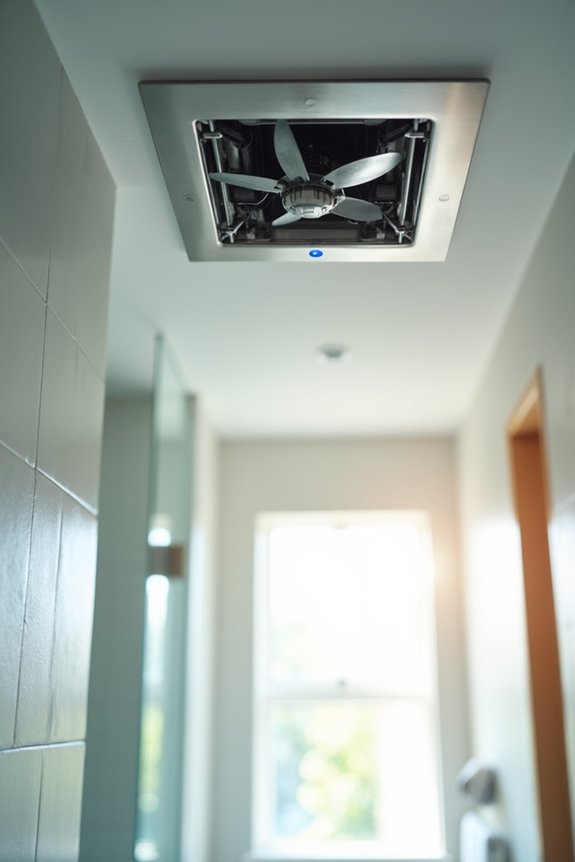
Ever wonder if flipping on your bathroom exhaust fan might actually help cool down your stuffy house on a hot day?
Here’s the honest truth: it depends. Your bathroom exhaust creates an air exchange—pulling indoor air outside. But here’s where it gets tricky. If outdoor air is hotter than what’s inside, that fan’s actually heating your house, not cooling it. Not exactly the relief you’re hoping for.
However, when outside air is cooler and drier than your indoor environment, your bathroom exhaust can work with you. The air exchange pulls that pleasant outdoor coolness inside while reducing humidity. It’s like opening windows strategically.
The key factor? Where makeup air enters. Large door gaps or loose seals mean warm outdoor air sneaks back in, undoing your cooling efforts. I’ve learned this the hard way. Tight houses with proper ventilation design? Those fans actually help.
How Bathroom Exhaust Fans Actually Move Air

So how exactly does your bathroom fan pull air out of your house? Your fan creates negative pressure—think of it like a vacuum. It sucks moisture-laden air outside, which means replacement air must flow in somewhere to balance things out. That make-up air sneaks through door gaps, cracks, or vents.
Here’s what matters: your fan’s rated power doesn’t tell the whole story. Ductwork twists, dampers, and restrictions reduce actual airflow. You might think you’re getting 80 CFM, but you’re actually getting less.
The replacement air source changes everything. If outside air’s hotter than indoors, you’re heating your house. Cooler outside air? That helps cooling. Understanding this connection explains whether your bathroom fan actually cools or just moves moisture around.
The Real Problem: Outdoor Air Sneaks In and Heats Your House
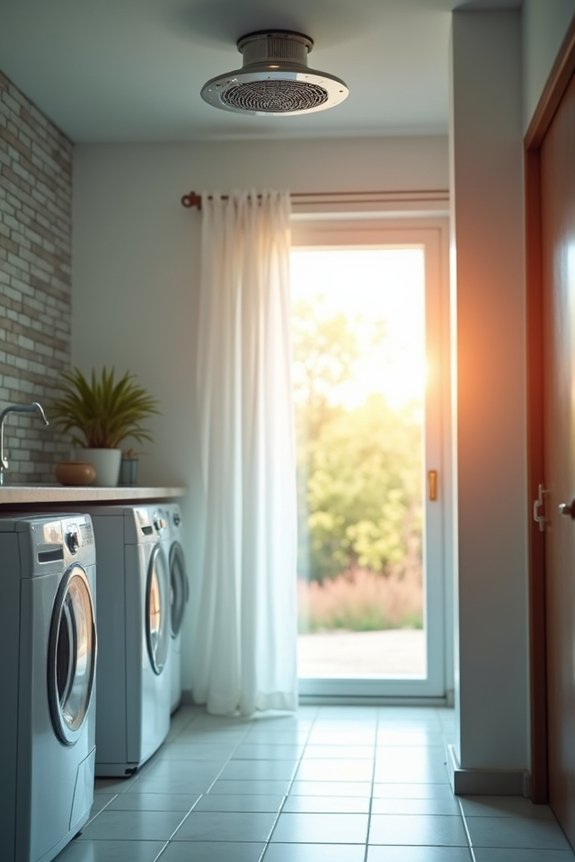
When you run your bathroom fan, it pulls air out of your house—and this is why that catches most people off guard: that missing air has to come from somewhere, so outdoor air sneaks in through cracks under doors, gaps around windows, and leaky ductwork to replace it. If it’s a hot day outside, that replacement air brings heat right into your home, which basically cancels out any cooling your fan might’ve done. This is why running your exhaust fan on a sweltering afternoon can actually warm your house instead of cooling it—the negative pressure you’ve created is like opening an invisible door to all that outdoor heat.
Negative Pressure Creates Air Leaks
The problem intensifies during hot months. That incoming make-up air isn’t cool; it’s whatever temperature exists outside. On a sweltering afternoon, you’re fundamentally inviting hot outdoor air inside while simultaneously trying to cool your home.
I watched this happen at my place. My bathroom fan ran faithfully while hot air snuck in through gaps I’d never noticed. The result? My AC worked overtime fighting air I’d inadvertently pulled inside.
Replacement Air Temperature Matters
When outdoor air is hotter than indoor air, that replacement air has to come from somewhere. My exhaust fan created negative pressure, so hot outdoor air sneaked in through gaps and leaks. Instead of cooling my house, I was warming it up.
The real problem? Continuous exhaust increases the volume of outdoor air that needs conditioning. If replacement air enters through large gaps under doors or windows, warm outdoor air infiltrates directly into my cooled spaces. That’s when my air conditioner has to work overtime.
The key variables that matter: fan CFM, outdoor temperature, and where make-up air enters relative to my conditioned spaces. Understanding these factors helped me stop fighting against my own cooling system.
Heat Load From Infiltration
When you run that exhaust fan continuously, you’re pulling about 4,200 cubic feet of air hourly from your home. That air has to come from somewhere. Outside makeup air sneaks through gaps, cracks, and leaky doors—and that’s where your real problem starts.
Think of it this way. Hot outdoor air weighs roughly 432 pounds per hour at 70 CFM. That mass carries heat inside using air’s specific heat capacity (0.24 BTU/lb·°F). The hotter it is outside, the bigger your cooling load becomes.
On scorching days, you’re inviting heat indoors. Those air infiltration pathways around your doors and windows are direct routes for outdoor warmth to settle into your space.
Use Dew Point to Decide When to Run Your Fan
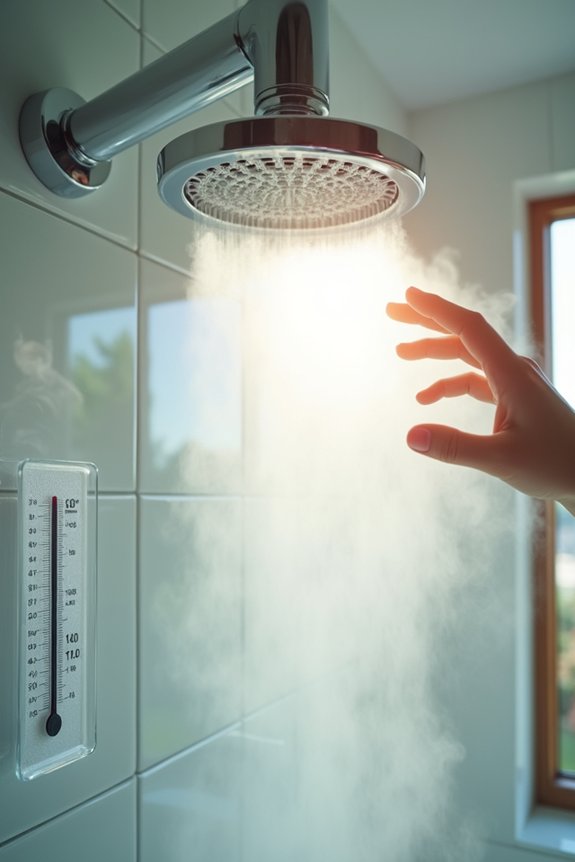
I’ve learned that running your bathroom fan isn’t just about flipping a switch—it’s about understanding what’s actually happening with the moisture in the air around you. The key is comparing your indoor dew point (basically how much moisture your bathroom air is holding) to what’s outside, because exhausting humid air only helps if the outdoor air is drier than what you’re trying to get rid of. Think of it like this: if you’re pushing steamy shower air outside, but the air coming back in to replace it is already loaded with moisture, you’re actually making your humidity problem worse, not better.
Compare Indoor Outdoor Dew Points
If your outdoor dew point is lower than what’s happening inside your bathroom, run that fan. You’re moving humid air outside without pulling in extra moisture. But if the outdoor dew point is higher? Stop right there. You’ll actually be introducing more moisture into your home.
Think of dew point as humidity’s honest scorekeeper. During a hot, muggy summer day, your outdoor dew point might be 70°F while your bathroom sits at 65°F after a shower. That’s your signal to keep the fan off. You’re protecting your home from unnecessary moisture.
Check both numbers before deciding.
Humidity Decision Framework Steps
Step 1: Check Your Bathroom
Estimate how humid it feels during and after your shower. That’s roughly your indoor dew point.
Step 2: Check Outside
Compare the outdoor air’s dew point to yours. Lower outdoor dew point? You’re in good shape.
Step 3: Compare Temperatures
Make sure outdoor air isn’t hotter than your home. Heat plus humidity equals a losing battle.
Step 4: Make Your Call
Run the fan only when outdoor air is both drier and cooler. Otherwise, you’re just pulling in moisture and warmth—defeating the purpose entirely.
This framework takes two minutes but helps protect your comfort and wallet.
When Bathroom Fans Actually Help (Cool Nights, Spring, Fall)
When does running your bathroom fan actually cool your house instead of just spinning air around? It works best during cooler nights in spring and fall when outdoor temperatures dip below what’s inside.
You’ll see real results when:
- Cool outdoor air enters – Your replacement air must be genuinely cooler than indoor air, not warmer
- Tight home with controlled air leakage – Make-up air comes through intentional paths, not warm gaps under doors or attic spaces
- Lower humidity creates comfort – Drier air feels slightly cooler, even if temperature barely drops
The trick? Monitor outdoor conditions. If that replacement air sneaks in through warm spots, it’ll heat your space instead. You’re trading stale air for fresh air when conditions align properly.
When Running Fans Backfires (Hot, Humid Days)
| Condition | Effect | Result |
|---|---|---|
| Hot day, fan running | Exhaust air leaves; hot outdoor air enters | Cooling load increases |
| Humid day, fan running | Exhaust air leaves; moist outdoor air enters | Dehumidification fails |
| Attic ducts + solar heat | Make-up air gains extra warmth | AC works harder |
The moisture in that replacement air undermines any humidity reduction you’d planned for. You’re basically inviting the problem inside.
Why Continuous Operation Wastes Energy
When you run your bathroom fan 24/7, you’re constantly pulling conditioned air out of your house and replacing it with outdoor air that your air conditioner then has to work harder to cool down—it’s like leaving a window cracked open year-round while your AC runs full blast. Your thermostat keeps fighting to maintain that setpoint, and every degree of temperature difference between the exhausted indoor air and the incoming outdoor air adds to your cooling load in BTUs per hour. You’re paying to cool the same air twice: once when your AC cools your home, and again when it has to recool the replacement air sneaking in through every crack and gap.
Replacement Air Heat Load
they don’t just remove air—they create a vacuum that demands replacement air from somewhere, and that somewhere is usually the great outdoors.
That outside air has to go *somewhere*. Here’s what happens:
- Hot outdoor air enters when you’re running AC—basically working against your cooling system
- Cold makeup air leaks in during winter, forcing your heater to work overtime
- Uncontrolled air paths mean that replacement air sneaks through cracks and gaps instead of entering strategically
A continuous 70 CFM exhaust pulls roughly 432 pounds of outside air hourly into your home. When that outside air differs significantly from your indoor temperature, you’re paying to condition air that’s immediately leaving. It’s like heating or cooling money you’re literally throwing out the window.
Thermostat Setpoint Stability Matters
All that replacement air sneaking into your home creates another problem: it throws your thermostat into overdrive.
Here’s what happens: when outside air enters through leaks and air changes occur, your cooling system constantly chases temperature swings. Your thermostat setpoint becomes a moving target. The compressor runs longer, cycles more frequently, and works harder than necessary.
I’ve learned this the hard way. Keeping one steady temperature setting—say, 72 degrees—prevents your system from constantly re-cooling after fluctuations. It’s like choosing consistency over chaos.
Why stability wins:
- Reduces compressor runtime and wear
- Prevents short-cycling that damages equipment
- Keeps energy costs predictable
- Extends your system’s lifespan
Don’t raise that thermostat when you leave. Seems counterintuitive, but it actually doubles cooling time when you return. A fixed setpoint means your HVAC works with you, not against you.
What’s the Real Cooling Cost? A Quick Calculation
that 70 CFM bathroom fan you’re running continuously is pushing about 4,200 cubic feet of air out of your house every hour—which sounds impressive until you realize it’s also forcing roughly 432 pounds of outdoor air back in to replace it.
This make-up air needs conditioning, and that costs energy. Consider these scenarios:
- Summer heat: Hot outdoor air enters, and your AC works harder to cool it down
- Winter cold: Chilly replacement air means your heating runs longer
- Shoulder seasons: Cooler outside temps might actually *help* your cooling load temporarily
The real impact? Your cooling cost depends entirely on that temperature gap between inside and outside. Bigger difference equals bigger expense. It’s physics, not magic.
Pair Fans With Ceiling Fans and Blinds
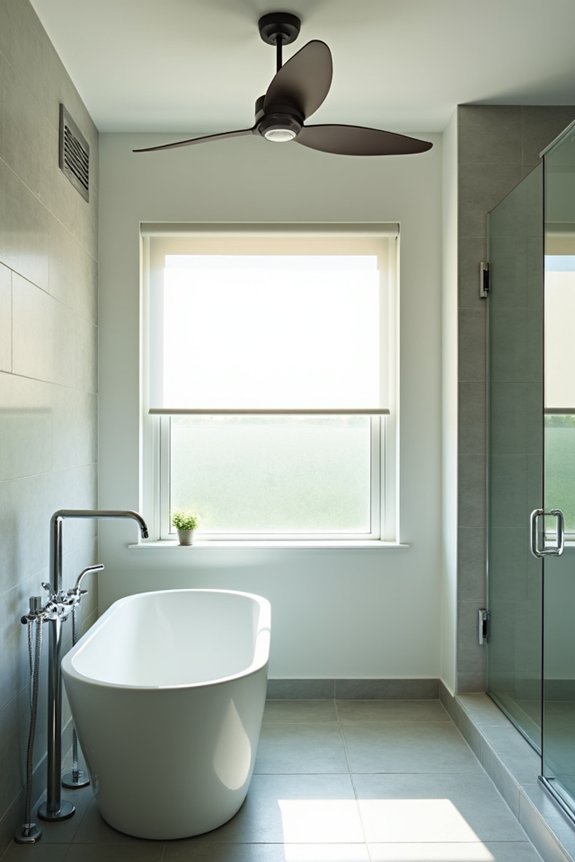
Now that you understand the real energy cost of running that bathroom fan, here’s the good news: you don’t have to choose between comfort and efficiency.
You don’t have to choose between comfort and efficiency—smart coordination makes both possible.
Pairing your bathroom fan with ceiling fans and blinds creates an effective cooling system. Here’s how it works: your bathroom fan exhausts humid air, while a counter-clockwise ceiling fan pushes cool air downward. Meanwhile, closed blinds block heat from entering.
Together, they work in coordination. The bathroom fan removes moisture, ceiling fans distribute air evenly, and blinds reduce solar heat gain. This combination lowers your overall cooling load without overworking your HVAC system.
The trick? Balance matters. Don’t run your bathroom fan too aggressively—you want coordination, not chaos. Adjust your ceiling fan speed and blind angles to match. It’s like conducting an orchestra where every instrument plays its part perfectly.
Whole-House Ventilation vs. Single-Room Exhaust
Why does your bathroom fan feel like it’s doing all the strenuous work while your house stays stuffy?
Single-room exhaust fans pull air from one space, but whole-house ventilation exchanges air throughout your entire home. Here’s what actually happens:
- Single fans remove hot air from bathrooms only, leaving other rooms untouched and potentially stuffy
- Whole-house systems control air temperature and humidity consistently by replacing exhausted air with outside air
- Make-up air matters most—if replacement air enters from hot crawlspaces or leaks, you’re heating rather than cooling
I learned this the hard way. Running my bathroom fan constantly didn’t cool anything because hot outside air crept in through gaps. A whole-house system with intentional cool air intake? That actually worked. The difference is strategic replacement air, not just exhausting what you’ve got.
Better Alternatives: HRV Systems and Strategic Window Opening
So you’ve figured out that bathroom fans alone won’t cool your house—good.
Now let’s talk about what actually works. HRV systems are the heavy hitters of home ventilation. They’re pricier than simple exhaust fans, sure, but they recover heat from outgoing air to precondition incoming air. That means your air conditioning doesn’t work overtime fighting temperature swings.
I’ve seen these systems improve tight homes significantly. They maintain humidity and air quality without the draft issues you get from cracking windows open. No backdrafting problems either.
Strategic window opening offers a simpler alternative. It’s free and gives you control, though it lacks HRV’s precision.
For most people seeking reliable, continuous ventilation without constant fiddling, HRV systems deliver results. They’re an investment that pays dividends in comfort and energy savings, especially in tight houses where passive ventilation falls short.
When to Run Your Fan and When to Keep It Off
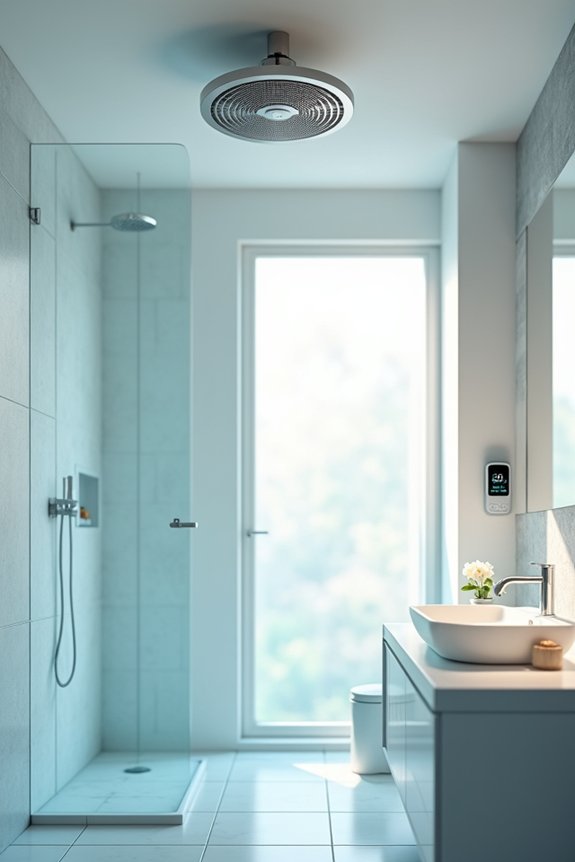
timing matters way more than you’d think. I’ve learned that running your fan isn’t about following some rigid schedule—it’s about reading the room, literally.
Here’s when I actually flip that switch:
- Summer mornings when outdoor dew point dips below indoor levels and outdoor temperature stays cooler than inside
- After showers if you’re confident outside air won’t bring unwanted heat or humidity indoors
- Never during peak heat when outdoor temperature rivals your indoor warmth
I watch my humidity levels closely. When outdoor conditions don’t support cooling, that fan just pushes expensive conditioned air outside. Smart sensors help me decide: vent or skip? This approach keeps my home comfortable without wasting energy or fighting moisture buildup.