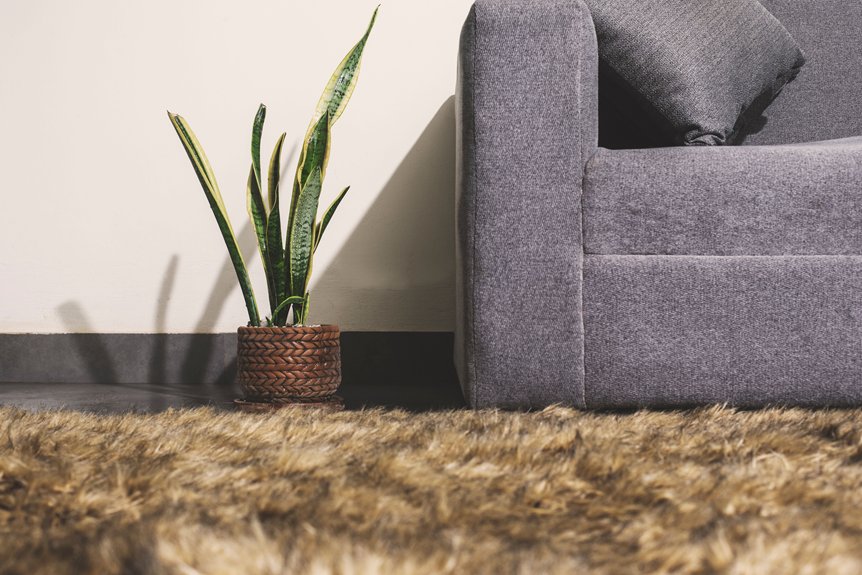
Yes, your rug should go under the couch—it anchors your space. I’ve found that tucking at least your sofa’s front legs onto the rug creates visual grounding and makes the seating zone feel defined rather than floating. In smaller rooms, that’s often enough.
Larger spaces? Go bolder with full coverage beneath all furniture. Either way, you’ll prevent slipping, protect floors, and define your room’s purpose right away. The key is measuring correctly and committing to the layout.
Should Your Rug Go Under the Couch? A Quick Decision Framework
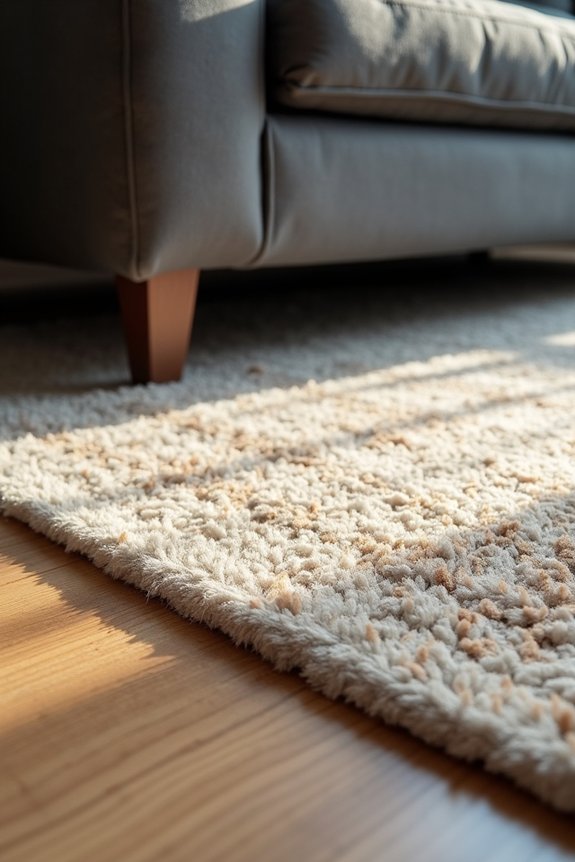
How do you know if your rug should slip under that couch of yours? It depends on your space and what you’re trying to achieve.
Deciding whether your rug slides under the couch depends on your space and design goals.
For smaller rooms, use partial underlay—just the front legs on the rug. This approach creates breathing room without making your seating area feel cramped. Extend the rug 6–12 inches beyond the sofa’s width on each side so nothing looks like it’s floating awkwardly.
For larger spaces, go bigger. A generously sized rug anchors your entire seating area, pulling everything together. It ties your furniture together visually.
Full coverage underneath protects floors from dents and keeps your rug from shifting around. Test it first with painter’s tape. Visualize before committing.
Why Rugs Under Sofas Define and Ground Your Space
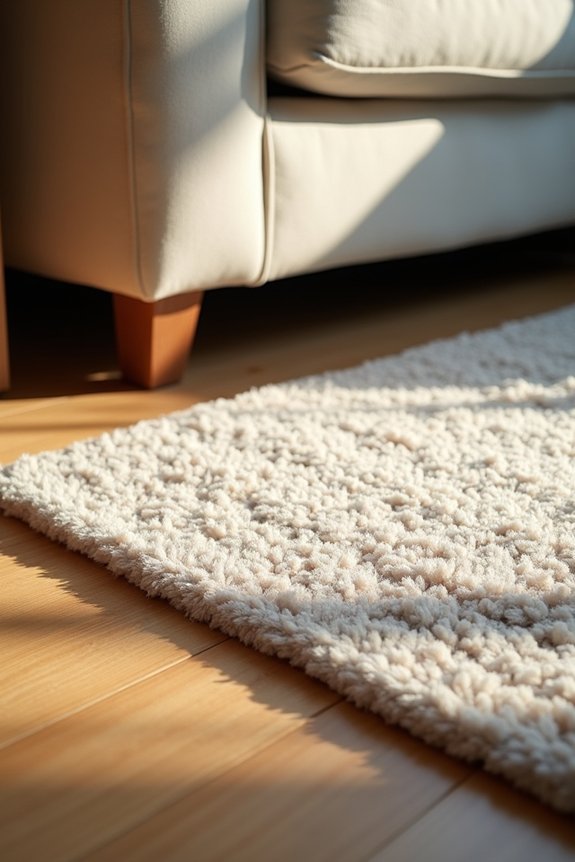
When you place a rug under your sofa, you’re anchoring your seating area and giving your furniture arrangement a clear sense of purpose and stability. This simple move helps organize a scattered living room into a defined zone where every piece has its place. By layering your rug beneath the sofa and extending it to other key pieces like your coffee table and chairs, you’re creating both a visual connection and an acoustic buffer that makes the whole room feel more deliberate and calm.
Visual Anchoring and Balance
Why does your living room sometimes feel like a furniture showroom rather than a cohesive space?
The answer often lies beneath your feet. When you place a rug under your sofa, you’re doing more than decorating—you’re creating visual anchoring that grounds everything. I’ve noticed how a properly positioned rug immediately makes my seating area feel deliberate, not scattered.
Here’s what happens: rug anchoring distributes visual weight evenly. Your sofa stops floating awkwardly and becomes part of something unified. The rug acts like an invisible connector, pulling your chairs, tables, and seating together into one cohesive zone.
Balance emerges naturally. The space feels complete. Your eye knows where to rest, and your guests instinctively gravitate toward the seating area. It’s one of the most direct ways to shift from “furniture collection” to “actual living room.”
Creating Defined Seating Zones
Beyond just looking put-together, a rug under your sofa organizes your entire room. When I finally placed a rug beneath my couch, everything clicked into place—literally. That single decision unified my scattered furniture into one cohesive seating zone.
Here’s what happens: rug placement anchors your setup, making the space feel deliberate rather than random. In my open-plan apartment, extending the rug under my sofa and chairs created invisible delimiters. Suddenly, my living area felt like its own room within the larger space.
For smaller rooms, positioning the rug just under the front legs visually expands everything. Larger spaces? Go generous—let that rug embrace all your seating pieces. You’ll notice smoother traffic flow immediately.
The result? You’ve created a gathering spot. Your seating zone becomes a genuine place where people naturally congregate.
The Anchor Effect: How Rug Placement Shapes Room Perception

I’ve learned that where you place your rug under the couch affects how a room functions—it communicates the room’s purpose before anyone sits down. Think of it like this: a rug that extends beneath your sofa creates a visual anchor point that says “this is where the living happens,” while one that stops short makes everything feel disconnected. Understanding how visual weight and spatial grounding work together helps you design a room that feels organized and deliberate.
Visual Weight Distribution
How does a simple piece of fabric pull a scattered room together with intentional design?
When I finally understood visual weight distribution through rug placement, my living room came together. Here’s what shifted things:
- Anchoring multiple pieces prevents your space from feeling fragmented and chaotic
- Aligning sofa front legs on the rug creates balance and guides attention naturally
- Extending beneath all main furniture distributes visual weight evenly across your seating zone
- Creating a shared grounding surface enhances flow in open-plan layouts
- Establishing proportion through strategic rug placement defines your room’s character
I realized my rug wasn’t just décor—it was the connective element holding my seating area together. When the rug anchors your sofa, coffee table, and chairs simultaneously, you’re not fighting against scattered visual chaos anymore. Instead, you’re building cohesion. That considered feeling? That’s visual weight doing its job.
Spatial Grounding Fundamentals
Now that you’ve got the big picture on visual weight distribution, let’s zoom in on what actually makes a rug work—the anchor effect.
When you place a rug under your couch, something shifts. Suddenly, your furniture isn’t floating in space anymore. It’s grounded. I noticed this the moment I positioned my rug properly—the whole room felt more intentional, more like home.
Here’s the thing about spatial grounding: your rug placement literally tells your eyes where to look. Aligning your sofa’s front legs on the rug creates a visual anchor point that says, “This is our gathering spot.” In smaller rooms, this trick even makes space feel bigger.
That shared foundation—whether your rug extends just under the front legs or stretches beyond—guides how people naturally move through your living area. It’s subtle psychology with real impact.
Small Rooms: Where to Position Your Rug
When you’re working with limited square footage, rug placement becomes everything—it’s a practical tool for making a cramped living room feel organized instead of haphazard.
I’ve learned that positioning your rug just beneath the sofa’s front legs creates visual balance. It grounds your seating area without eating up precious space. Here’s what works in small rooms:
- Place the rug so it runs just beneath the front legs
- Extend it six to twelve inches beyond the sofa’s width on each side
- Leave roughly 40 centimeters between the rug and walls
- Choose lighter, low-profile rugs that complement without overpowering
- Layer a smaller patterned rug over a neutral base for depth
This approach prevents that floating-island feeling. Your room suddenly feels more open. The rug becomes an anchor, not a space-stealer. It’s the practical solution that actually works.
Medium and Large Rooms: Full Coverage vs. Partial Placement
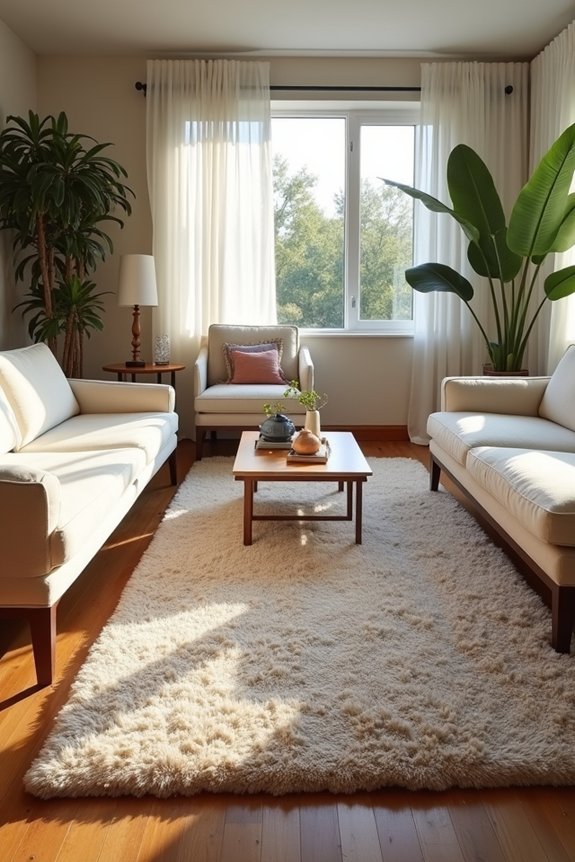
When I’m helping folks figure out rug sizing in bigger spaces, I always come back to the same question: *do you want your rug to anchor everything together, or do you prefer it to gently frame just your seating zone?* Full-coverage rugs—where your sofa and chairs all sit on the same rug—create a unified look that makes a room feel deliberate and connected. Partial placement, though, gives you flexibility; it can look just as polished while letting you play with your furniture arrangement without the commitment of a massive rug purchase.
Full Coverage for Cohesion
A full-coverage rug beneath your sofa creates one unified, intentional zone. I’ve watched this happen countless times—pieces that felt scattered suddenly belong together.
Here’s what a full-coverage approach gives you:
- Anchors all major furniture at once
- Creates acoustic warmth and softness underfoot
- Prevents visual fragmentation in open layouts
- Brings cohesion to flexible, oversized setups
- Keeps every seating point within the rug footprint
Yes, upfront costs run higher. Maintenance requires attention too. But here’s the thing: when everything feels connected, your whole room functions differently. You’re not just arranging furniture—you’re creating a gathering place where people naturally want to stay. That’s the power of going full-coverage.
Partial Placement for Flexibility
What if you didn’t have to choose between a grounded room and the freedom to rearrange?
Partial rug placement gives you exactly that. Instead of covering your entire floor, I extend my rug only under the front legs of the sofa or stop it short of the walls. This approach keeps my seating arrangement flexible—I can shift furniture around without worrying about the entire rug becoming misaligned.
Here’s what makes this work:
- Traffic flow stays clear. Edges don’t trip you up or limit movement.
- Reconfiguring’s easier. Your seating arrangement adapts without reworking everything.
- Rental-friendly. Perfect if you’re temporary or love changing things up.
I use painter’s tape to preview how my furniture and rug interact before committing. You’ll see exactly how your space wants to breathe.
Sectionals and Non-Standard Layouts: Rug Placement Strategies
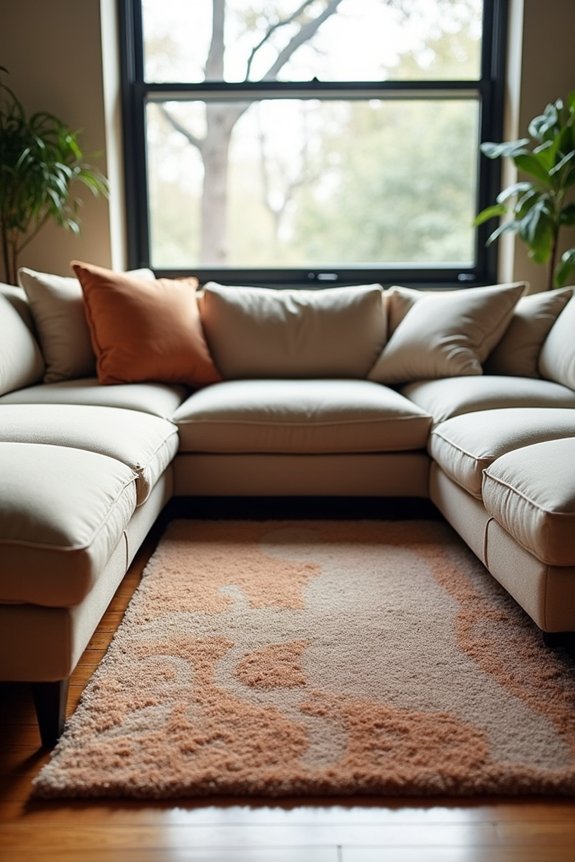
How do you anchor a sectional that sprawls across your living room like it owns the place? I’ve learned that successful rug placement for sectionals requires thinking beyond traditional rules. Here’s what actually works:
- Cover major contact points where people sit most
- Extend the rug beyond sofa edges for cohesive framing
- Layer a larger base rug with smaller patterned accents for texture
- Use painter’s tape to preview dimensions before committing
- Unify flexible zones by placing the rug beneath the sectional and adjacent pieces
In irregular spaces, partial rug placement under your sectional creates visual grounding without demanding perfect room shapes. I’ve found that this approach builds intentional, welcoming zones. Your sectional becomes part of the design story, not just furniture fighting for space.
How Much Floor Should Show? The 6–12 Inch Rule
Ever stood back from your freshly placed rug and felt something was *off*—even though you couldn’t quite name it?
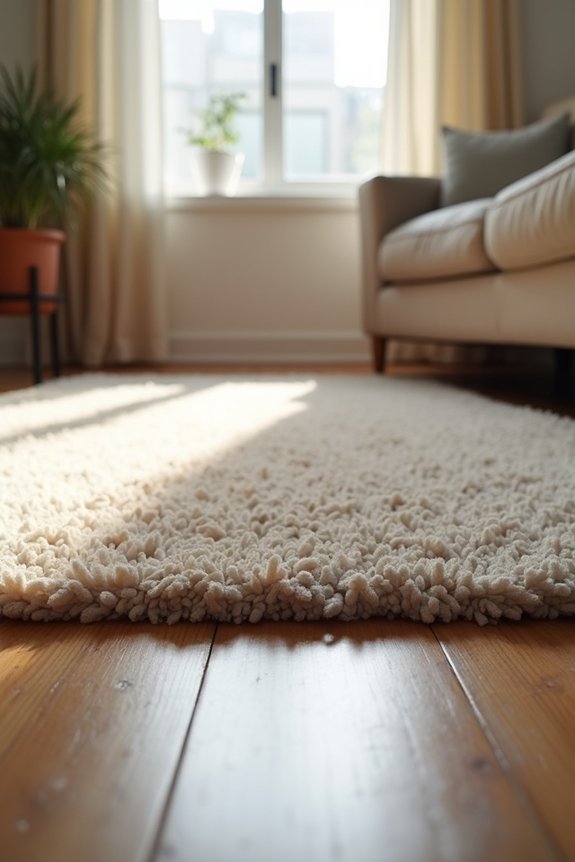
That’s usually about balance. I’ve learned the 6–12 inch rule works well: your rug should extend about 6 to 12 inches beyond your sofa on each side. This rug extension creates harmony without making your space feel swallowed whole.
The 6–12 inch rule: extend your rug just beyond the sofa on each side for perfect harmony.
Here’s why it matters. Too much floor showing? Your seating looks disconnected and lonely. Too little? The room feels cramped. That sweet spot—where a modest amount of floor shows around your furniture—grounds everything beautifully.
In smaller rooms, I let the rug tuck partially under the sofa’s front legs. This visual trick makes the space feel more deliberate and connected. Larger rooms? I extend further, so the rug grounds all your main seating pieces together.
Matching Rug Placement to Your Design Style
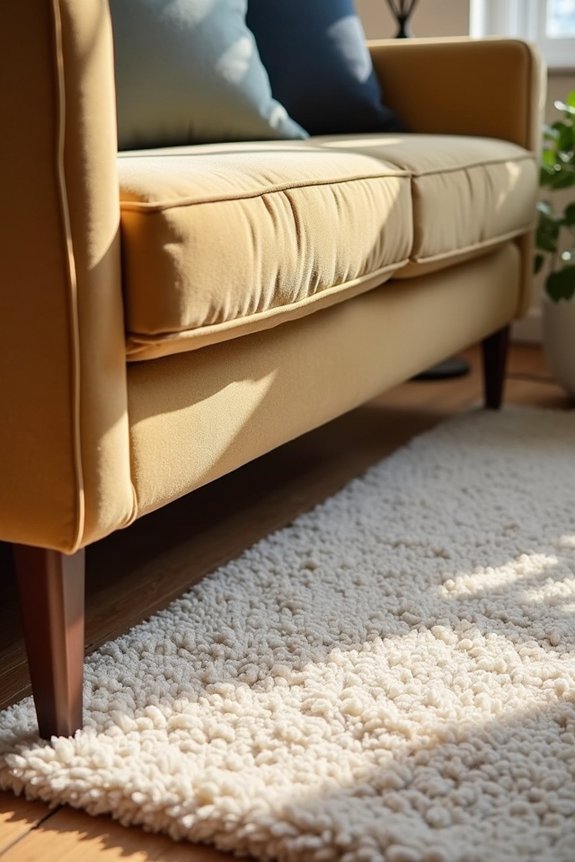
Your design style shapes *how* your rug should sit under that couch, and I’ve learned this the hard way by moving the same rug around my living room more times than I’d like to admit. If you’re drawn to modern minimalist spaces, you’ll want that rug anchoring your sofa completely—think bold, confident placement that creates a visual statement without cluttering the room. But if boho or eclectic style speaks to your soul, you have permission to break the rules: pull that rug slightly off-center, layer it with smaller patterned pieces, and let it feel intentionally *imperfect*.
Modern Minimalist Anchoring
When I first tried arranging my living room with a minimalist approach, I realized that rug placement wasn’t just about comfort—it was about creating visual calm.
Rug anchoring in minimalist design means making intentional choices that reduce clutter visually. Here’s how I’ve mastered it:
- Place your rug under the sofa’s front legs or entirely beneath it
- Choose neutral tones like graphite or pearl that blend harmoniously
- Align the rug about 20–30 cm wider than your sofa on each side
- Center furniture with the rug to reinforce streamlined flow
- Consider full-coverage rugs under multiple pieces for a unified zone
This approach worked well in my space. The rug became invisible—not unnoticed, but so perfectly integrated that it simply functioned as intended. No visual noise. No chaos. Just a cohesive, breathing room that felt deliberate and calm. That’s what thoughtful minimalist design achieves.
Boho Layering Techniques
While minimalism whispers through clean lines and invisible anchors, boho design speaks in a different language entirely—one of color, texture, and intentional imperfection.
I’ve discovered that boho layering turns rug placement into storytelling. Instead of perfect alignment, I offset my smaller patterned rug slightly to the side, letting it peek out naturally. This approach celebrates collected beauty rather than strict symmetry.
| Technique | Placement | Effect |
|---|---|---|
| Base Layer | Neutral underneath | Foundation |
| Top Layer | Colorful, offset | Personality |
| Front Legs | Partially on rug | Flow |
| Side Positioning | Asymmetrical | Authenticity |
When you layer rugs intentionally, you’re creating zones while maintaining movement. Your boho layering becomes an expression of who you are—unstructured, genuine, beautifully imperfect. This isn’t about following rules; it’s about feeling at home.
Layering Rugs for Depth and Budget-Friendly Impact
How’d you like to completely redo your living room without spending a lot on new furniture? Layering rugs works well for this. I’ve found that combining a neutral base rug with a smaller, colorful patterned layer creates visual interest right away.
Here’s what makes this approach work:
- Adds depth without expensive renovations
- Creates texture by mixing different pile heights
- Tells your story through travel finds and crafted pieces
- Keeps costs down by maximizing existing pieces
- Looks deliberate rather than accidental
Place your smaller rug slightly offset under the sofa’s front legs. This technique suits boho and eclectic spaces well. I use painter’s tape first to preview arrangements—honestly, it’s saved me from regrettable decisions. You’re not just decorating; you’re building a space that belongs to you.
Keep Your Rug Anchored: Preventing Slipping and Curling
Most people don’t realize their rug’s biggest enemies are gravity and movement—but I’ve learned this the hard way. When I finally placed my rug under the couch, everything changed.
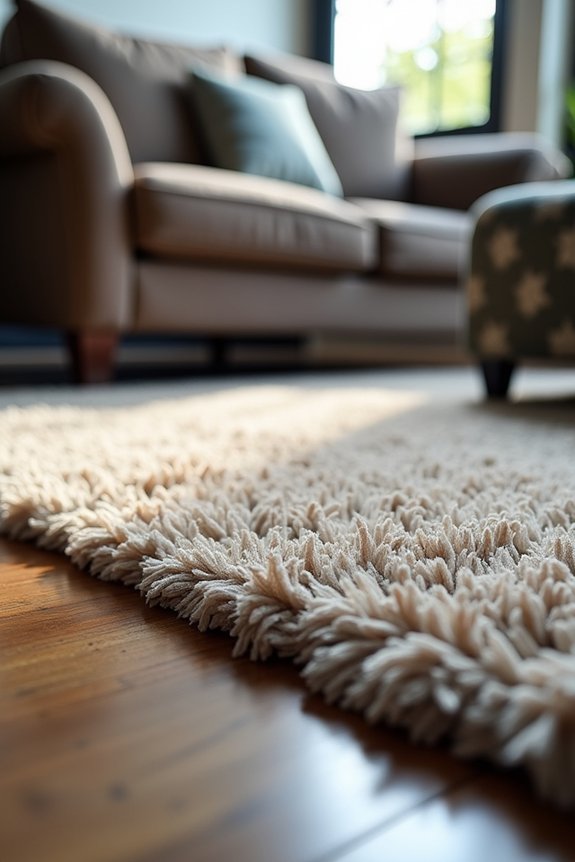
Here’s what I discovered: a rug under couch actually stays put. The sofa’s weight anchors it effectively, preventing that annoying sliding that happens during vacuuming or when you’re walking around. Even better? Adding non-slip liners underneath creates serious grip on smooth floors.
The friction between your rug and floor reduces shifting and curling at the edges. I’ve watched my corners stay flat instead of folding up.
Want results that work? Extend your rug beyond the sofa’s front legs. This keeps edges flat and prevents tripping hazards. Pair everything with quality non-slip liners, and you’ve got a setup that actually works.
How Rugs Under Sofas Protect Floors and Prevent Damage
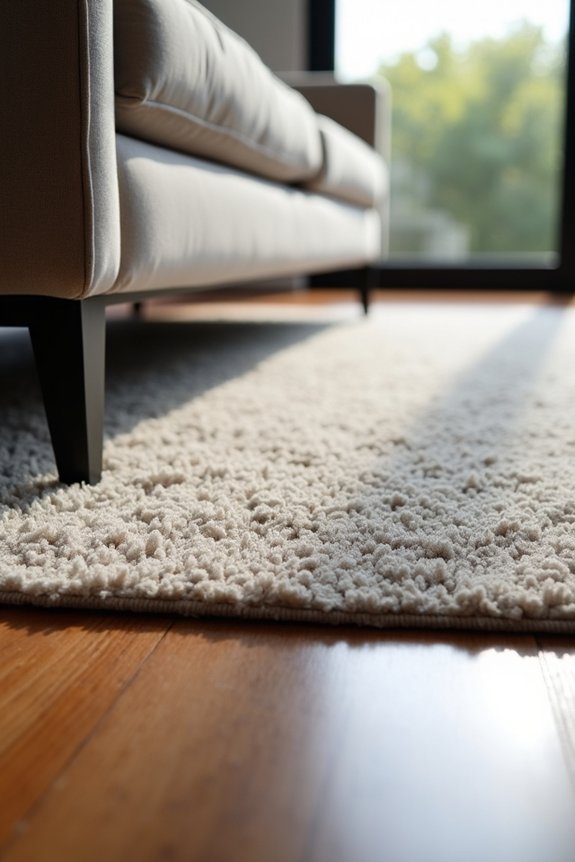
Beyond keeping your rug flat and in place, there’s something I didn’t expect when I started anchoring my sofa on a rug: my floors actually started looking better.
When you place a rug under your sofa, you’re creating a protective barrier that does serious work. Here’s what I’ve noticed:
- Distributes weight evenly across hard floors
- Reduces dents and scratches from furniture legs
- Prevents edge curling that damages wood
- Keeps dust contained in defined zones
- Adds non-slip stability with furniture pads
The floor protection benefits are real. My hardwood no longer shows those ugly indentations where my sofa sat. Using a non-slip rug liner underneath keeps everything in place while safeguarding my floors. It’s like giving your home a protective layer against damage. The difference a rug under your sofa makes is worth considering.
Cleaning Under the Sofa: Maintenance Tips for Anchored Rugs
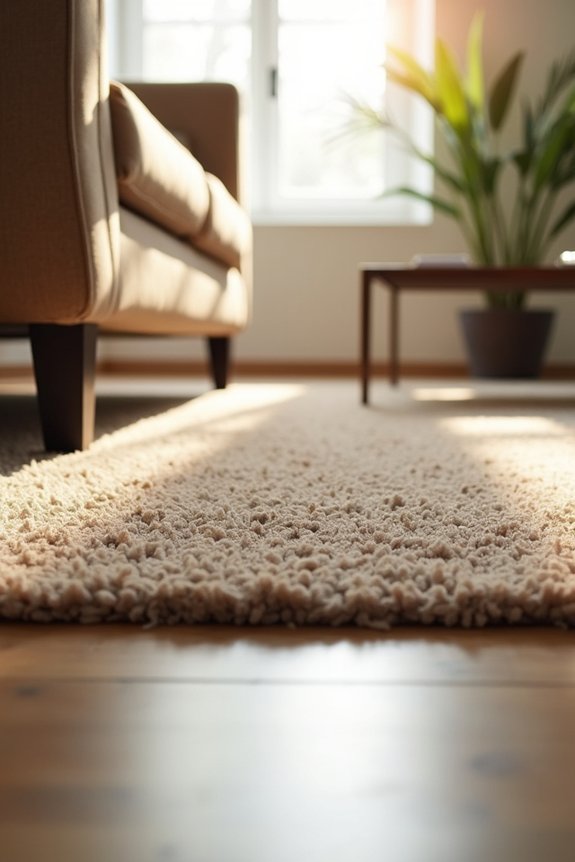
When’s the last time you actually looked under your sofa?
I’ll be honest—it’s easy to forget about cleaning under the sofa once you’ve anchored your rug in place. But here’s the thing: dust loves hiding spots. Regularly lifting your sofa to vacuum beneath it prevents grime from settling into your rug placement area.
Your maintenance routine:
- Vacuum under and around the anchored rug weekly
- Check for debris trapped along edges
- Lift the sofa monthly for deep cleaning
Low-pile or flatweave rugs make cleaning under the sofa straightforward—no thick fibers trapping dirt. If your rug shifts or edges curl during this process, reposition it and retape the backing as needed.
This simple habit keeps your home fresh and your rug looking great for years.
Rental-Friendly Rug Placement for Flexible Living
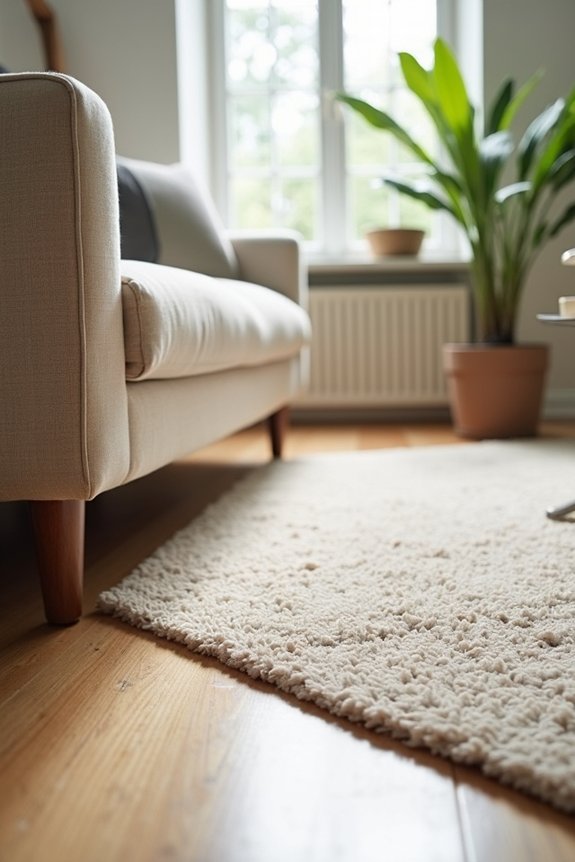
If you’re renting or planning to move soon, fully anchoring your rug under the sofa might feel like committing to a relationship you’re not ready for.
That’s where rental-friendly rug placement helps. Flexible living deserves flexible solutions. Here’s how to create a defined space without permanent commitment:
- Preview first using painter’s tape to map out your layout before buying
- Extend partially under front sofa legs only for visual definition in compact rooms
- Layer strategically with smaller, portable rugs over a larger base rug
- Stabilize smartly using non-slip liners and furniture pads to prevent shifting
- Think portable so you can rearrange whenever inspiration strikes
This approach lets you belong to your space without feeling trapped. You’ll maintain easy movement while defining your seating area—all without landlord concerns or moving day regrets.
Measuring and Investing in the Right Rug Size
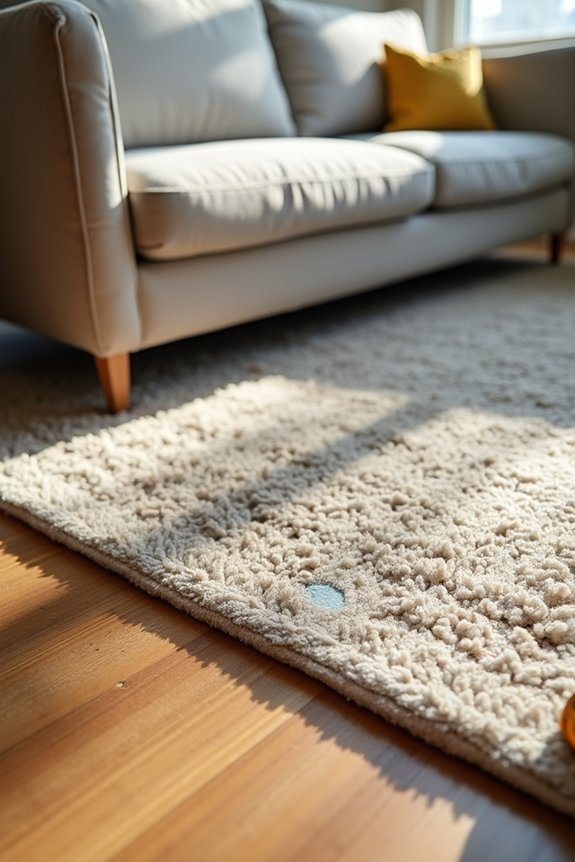
How do you know what size rug actually works for your space? I’ve bought rugs that looked perfect in the store, then got them home and wondered what I was thinking. The answer is measuring first.
Start by measuring your sofa length, then add 20–30 centimeters on each side. This creates visual balance and prevents that awkward floating feeling. I use painter’s tape to outline dimensions before purchasing—it helps with planning.
| Room Size | Rug Approach | Key Benefit | Example |
|---|---|---|---|
| Small | Front legs only | Visual connection | 5×7 ft |
| Medium | Major contact points | Balanced look | 8×10 ft |
| Large | Beneath all furniture | Anchored seating | 9×12 ft |
| Sectional | Generously sized | Room cohesion | Custom fit |
Getting the measurements right means investing in a space that actually works for you.
Your Rug Placement Checklist
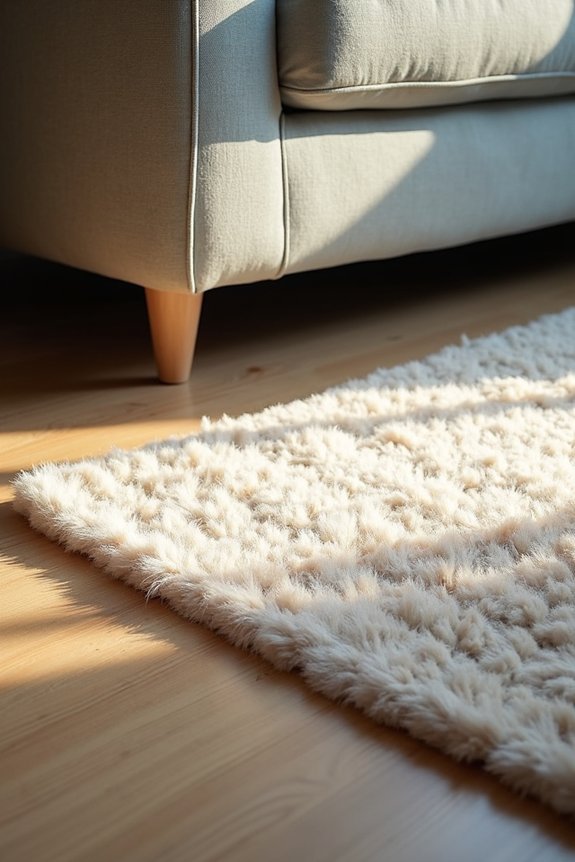
Once you’ve measured and picked out your rug, the real work begins—getting it positioned *just right*.
Proper rug placement makes your space work better. Here’s what I check every time:
- Anchor placement: Position the rug under-sofa to define your seating area
- Edge spacing: Leave 20–30 centimeters beyond the sofa on each side
- Wall distance: Keep about 40 centimeters between the rug edge and walls for openness
- Safety measures: Add a non-slip rug liner to prevent shifting and floor damage
- Flexibility needs: Decide if you want full under-sofa anchoring or adjustable placement
Getting this right means your rug stays put and your room looks organized. When everything’s aligned—your rug placement checked, your furniture secure—you’ve created a space that works well for everyone in it. That’s the goal, really.