
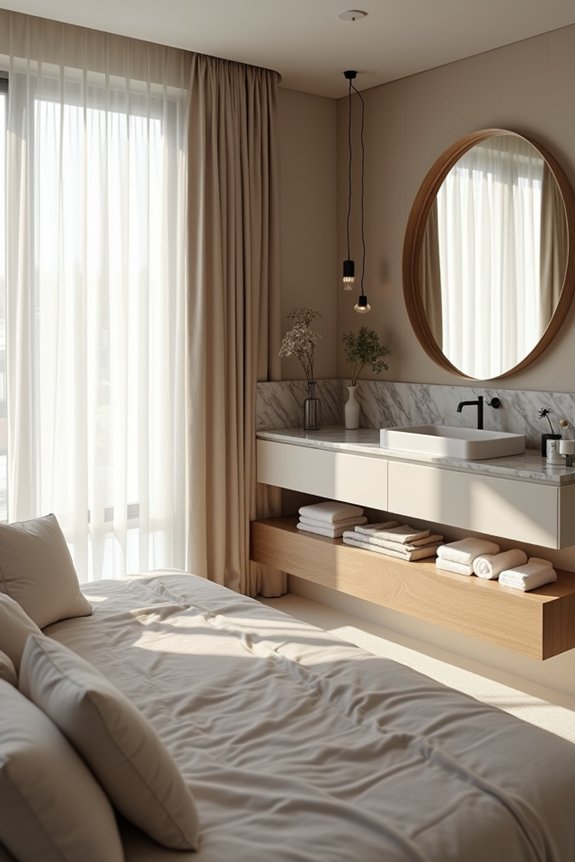
Your bedroom and bathroom don’t *need* to match—but they should feel connected. Think of it like wearing a coordinated outfit: your top and pants aren’t identical, but they work together. Cream walls, white fixtures, and shared wood tones create harmony without feeling like a hotel clone.
You’re really deciding between unified calm or distinct personality in each space. Either way, a consistent color palette of two to three main colors keeps everything looking deliberate rather than random. There’s a smarter way to nail this balance.
Do Your Bedroom and Bathroom Need to Match?
they don’t. Not even close.
Cohesive spaces don’t require matching. Instead, I focus on *shared neutrals*—think soft grays, warm whites, or gentle beiges. These create flow without demanding perfection.
A consistent color palette of two or three main colors works well. My bedroom features warm terracotta tones while my bathroom stays bright and airy. Both spaces feel purposefully designed, not forcibly twinned.
The approach? Complementary textiles and materials tie everything together. Shared linens, similar wood finishes, coordinated metals. Personal touches in each room prevent that cookie-cutter feeling.
Your spaces can absolutely feel connected without being identical. That’s actually the right balance.
Key Factors That Help You Decide (Matching vs. Individualized)
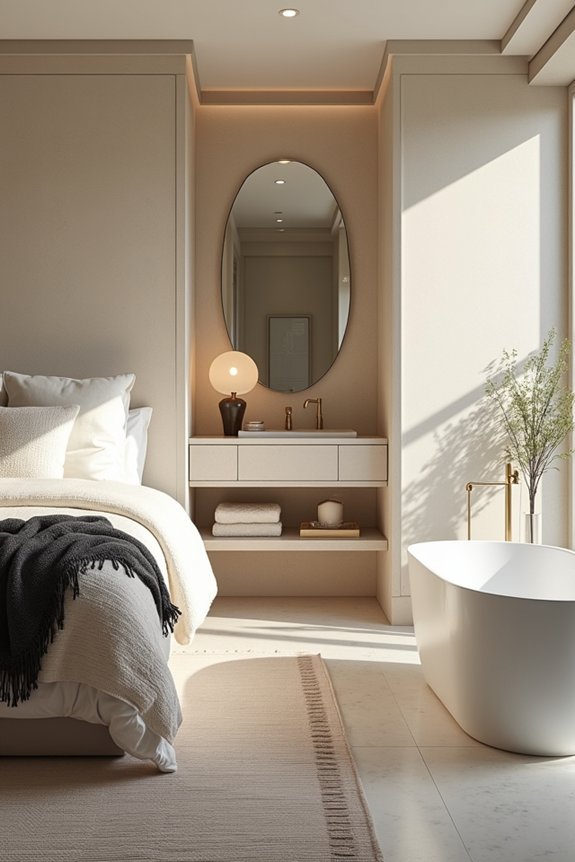
So how do you actually choose—matching or individualized? I’ve learned it depends on what matters most to you.
Consider your cohesion needs. Do you want your spaces to feel instantly connected? Matching color palettes create that unified feeling. But here’s the thing: you don’t need identical rooms to feel like they belong together.
Think about undertones instead. I discovered that shared warm or cool undertones across different colors maintain connection without monotony. Gold accents, for instance, tie spaces together beautifully while allowing contrast.
Ask yourself honestly: Do you crave visual harmony or room variety? Your answer determines everything. Neither choice is wrong—it’s about what works for your suite.
Matched Designs: Popular Styles and Color Pairings

When you’re ready to create a *matched* look between your bedroom and bathroom, nailing your color palette and design theme makes a real difference. You’ll want to pick two to three main colors that feel right to you—think soft neutrals with a pop of sage green, or warm whites paired with terracotta accents—and then weave them through both spaces so your eye naturally flows from one room to the next. Once you’ve locked in your colors, choosing a unified style (like modern farmhouse or minimalist luxe) keeps everything feeling deliberate rather than accidentally mismatched, which honestly just feels better when you’re brushing your teeth at 6 a.m.
Color Palette Coordination
Ever notice how some bedrooms and bathrooms feel like they belong together, even when they’re totally different spaces?
That’s the benefit of color palette coordination. You don’t need matching everything—just pick two or three main colors that work together. Analogous colors (neighbors on the color wheel) create natural harmony without feeling forced.
Think soft blues paired with greens, or warm creams mixed with gentle taupes. These combinations work well and feel relaxed.
Here’s what works:
- Repeat your main colors in different ways—wall paint, towels, accents
- Use one color as your anchor (walls), others as supporting players
- Let accessories do the talking
When your bathroom mirrors your bedroom’s color story, you’ve created coordination that connects the spaces. It’s subtle. Powerful. Worth the thought.
Design Theme Continuity
Now that you’ve got your color palette working, it’s time to go deeper—picking an actual design theme that’ll tie your bedroom and bathroom together. Think of your theme as the personality of your space. When I chose modern farmhouse for mine, everything came together.
| Theme | Bedroom Vibe | Bathroom Feel | Shared Elements |
|---|---|---|---|
| Modern Farmhouse | Cozy, rustic | Warm, inviting | Wood + metal fixtures |
| Boho | Eclectic, relaxed | Peaceful, artistic | Woven textures, earth tones |
| Minimalist | Clean, calm | Serene, organized | Neutral palette, simple lines |
| Coastal | Breezy, light | Spa-like, fresh | Blues, whites, natural materials |
Your design theme continuity creates matched finishes across both rooms. I’m talking coordinated hardware, similar countertop materials, and lighting that tells the same story. When your bathroom mirrors your bedroom’s calming energy through the same theme, you’ve created something worth noticing—a sanctuary that works by design.
How to Match Your Decor Without Identical Duplication?
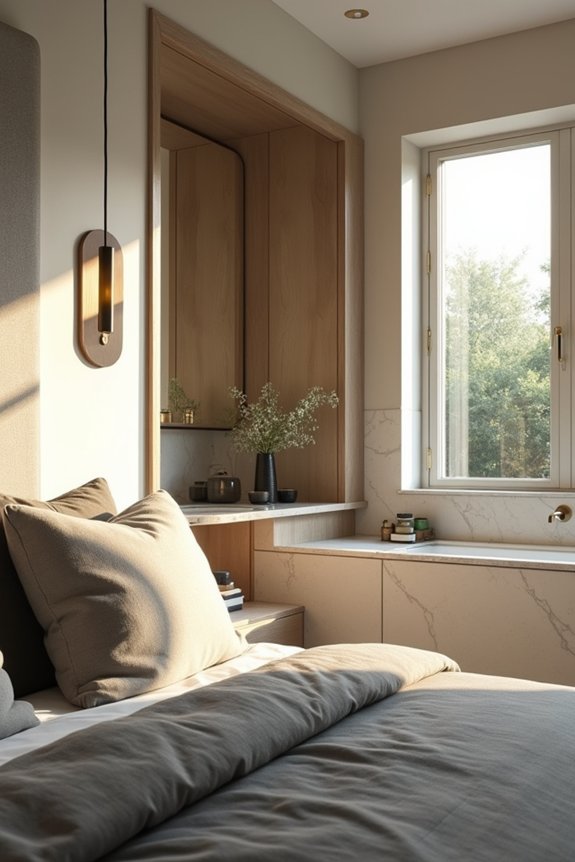
How do you create a bedroom and bathroom that feel like they belong together without making them look like twins separated at birth?
Start with a neutral palette. Paint both rooms the same soft gray or beige, then layer in color through textiles. Your bedroom gets bold bedding while your bathroom showcases colorful towels. This approach creates connected spaces without repetition.
Next, repeat materials. If your bedroom features wood nightstands, echo that with wooden shelving in the bathroom. Same goes for metals—brass fixtures connect naturally.
Accent echoes tie everything together. Paint a subtle accent wall in your bedroom, then reflect it as a lighter shade or smaller accent in the bathroom. Maybe a navy wall becomes navy towels elsewhere.
This strategy makes spaces feel linked by design choice, not copied. You’re creating family, not clones.
Individualizing Your Bathroom While Maintaining Harmony?
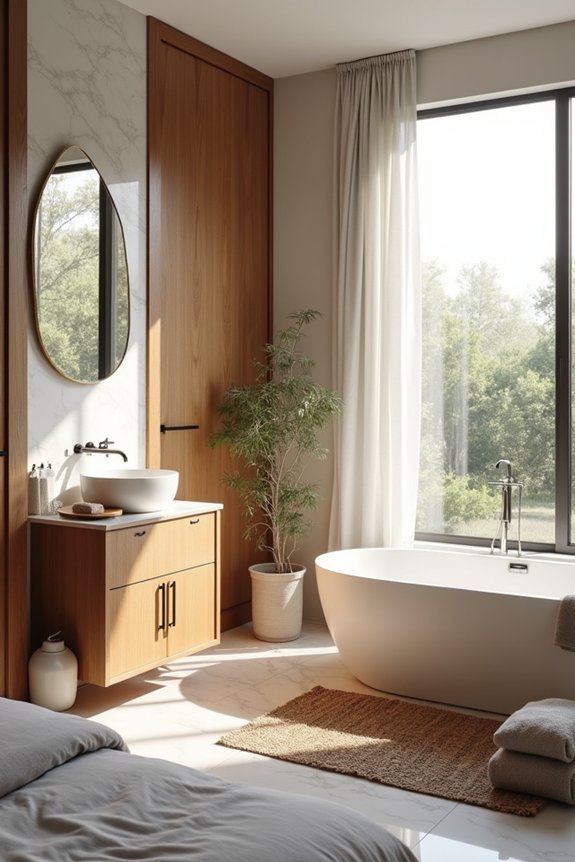
What if your bathroom could feel like its own special retreat while still belonging to the same home as your bedroom?
I’ve discovered that *cohesion* doesn’t mean copying. Your bathroom can shine with personality through distinct accent colors or bold tile patterns—just keep shared undertones like wall neutrals constant.
Creating contrast thoughtfully matters. If your bedroom feels calm and minimal, let your bathroom be slightly bolder. Different shower curtains and bath mats work beautifully when they echo your bedroom’s color family.
Texture ties everything together. I use matching hardware, lighting fixtures, and materials—like wood shelving or brushed metals—across both spaces. This subtle connection makes rooms feel deliberately designed rather than mismatched.
Think of it as a conversation between spaces. They’re distinct, but they’re *speaking the same language*.
Three Elements That Connect Any Bedroom-Bathroom Pair
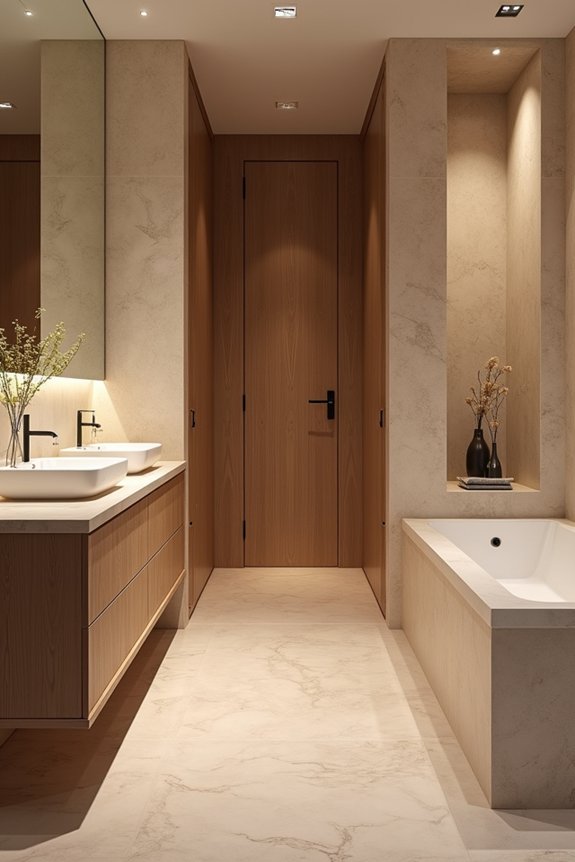
Ever noticed how some homes feel like a jumbled puzzle, while others flow smoothly from room to room?
I’ve discovered three powerful connectors that link bedroom-bathroom pairs into cohesive sanctuaries. First, a neutral palette creates breathing room—think soft grays or warm whites on walls, letting personality emerge through textiles. Second, shared finishes in hardware and lighting tie spaces together naturally. Chrome fixtures, brass handles, or matte black accents appearing in both rooms whisper connection without shouting it.
Third, matching accents through artwork or decorative objects complete the picture.
| Element | Bedroom | Bathroom |
|---|---|---|
| Wall Color | Soft gray | Soft gray |
| Hardware | Brass | Brass |
| Textiles | Linen | Linen |
| Lighting | Warm | Warm |
| Accent | Botanical art | Botanical art |
These three elements create harmony that works together naturally, making your spaces your own.
Build With Neutrals: Why Stone, Gray, and Cream Simplify Coordination
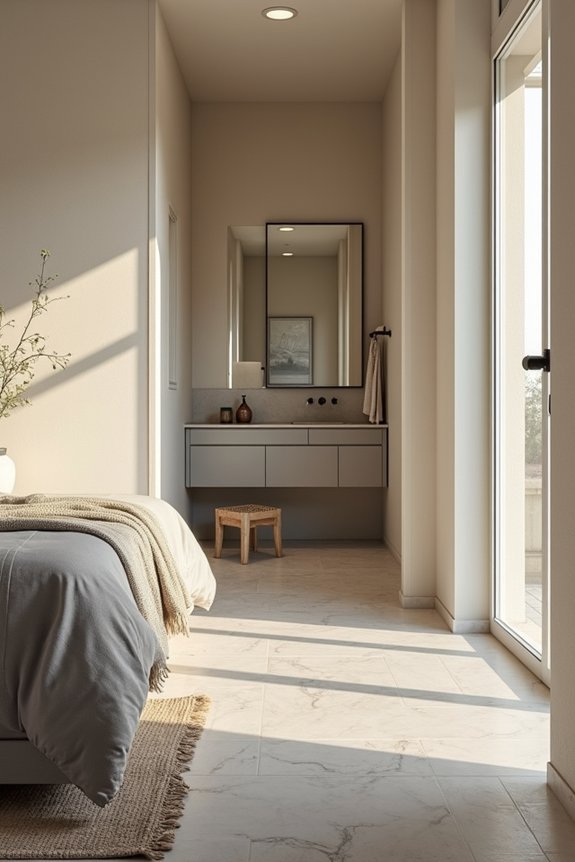
Somewhere along my decorating journey, I realized that chasing perfect matches between my bedroom and bathroom was making everything harder, not easier. That’s when I discovered the value of neutrals.
Stone, gray, and cream aren’t boring—they’re practical. Here’s why I use them:
Stone, gray, and cream create versatile backdrops that streamline decorating decisions while letting your personal style shine through.
- Creates a versatile backdrop that works with any accent color you choose
- Stone-inspired textures add natural variation without demanding exact matches
- Gray scales anchor both spaces while letting you express yourself through textiles
- Cream walls soften contrasts and pair beautifully with white fixtures and wood
- Streamlines decision-making for rugs, towels, and accessories
When I stopped obsessing over matching everything perfectly, coordination became straightforward. These neutral foundations let your bedroom and bathroom feel connected without feeling identical.